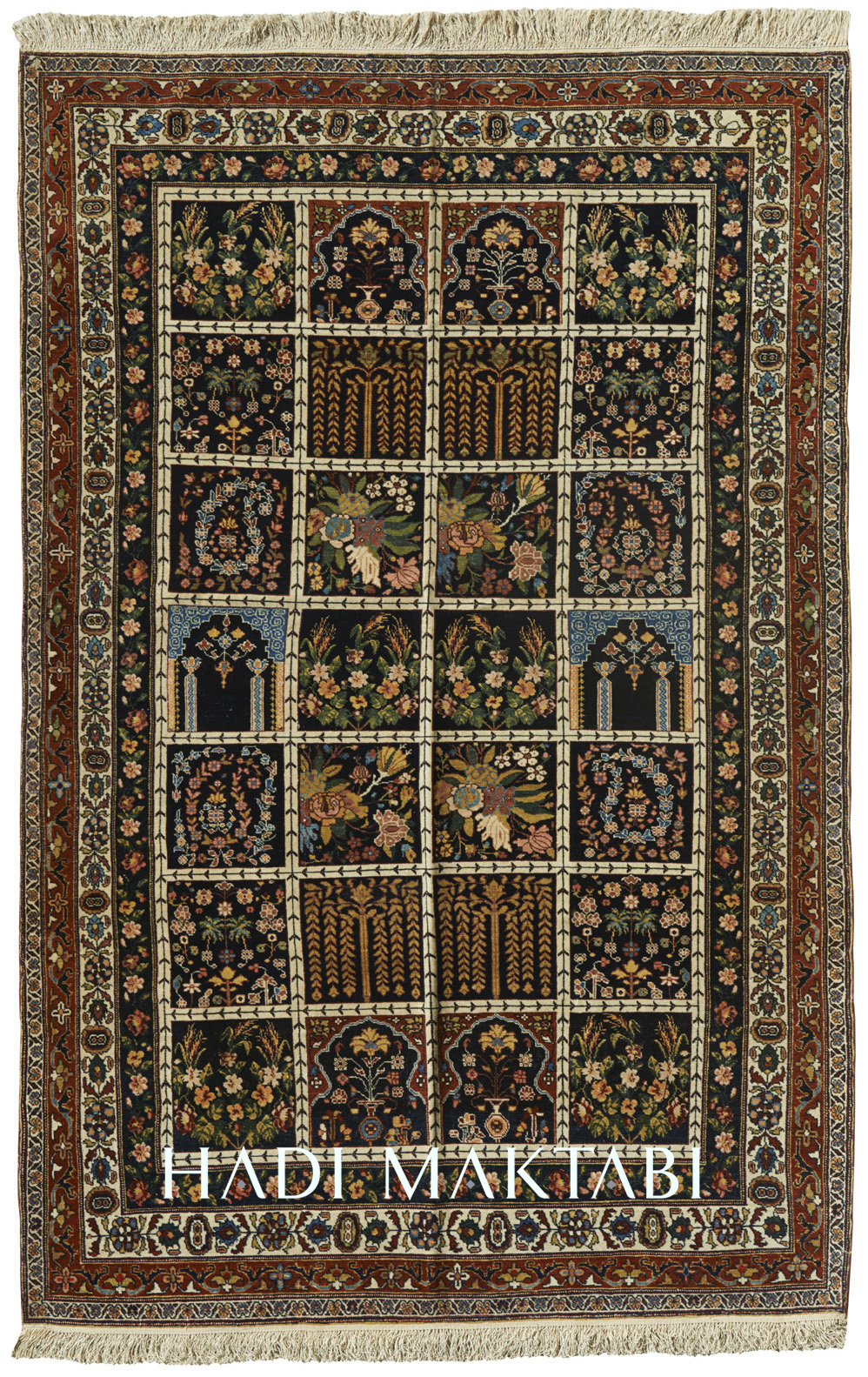
Number YR870
Type Workshop
Material Wool
Style Geometric
Origin Senneh
Size 200 x 132
Age 1880
This beautiful rug descends from an illustrious long line of Safavid Garden Carpets. The pattern of square floral cells has become associated with the Bakhtiari in the 20th century but in the 19th century it was still evolving and developing, mostly among the Kurds of western Persia (see my book for a thorough discussion). This is the only such instance known on a Senneh carpet. The weave is very sturdy and fine and the range of vegetable dyes outstanding, albeit not one associated with Senneh either. Most intriguingly, the rug was woven in the opposite direction to the design. Why?
To me personally there is no surprise, event or frankly anything that gets me more excited than the purchase of a treasured piece of understated artwork such as that of a proper vintage/antique carpet. The sourcing, grading and authentication of these pieces is no small task but is of the highest importance. Through the respected dealer Hadi Maktabi all that is guaranteed, and rest assured the one thing I can guarantee personally as a client is a first class service from the initial selection process till it gets delivered right to your door step. It was an undeniably special experience, with hundreds of carpets to choose from, will definitely be visiting again. Thank you dear Hadi. Habeeb Al Monawer, Kuwait 🇰🇼
“You don’t just buy a rug from Dr Maktabi... It’s an experience, a rich one! You learn about history, culture & art. And more importantly you feel euphoric!” Dr Siamak Abolhassani, Expert Medical Care Clinics, Victoria, Australia 🇦🇺
As a carpet collector of 30 years, I have noticed a decline in the amount of truly unique and high quality carpets on the market. I have also noted a decline in the knowledge of merchants, generally. Hadi Maktabi stands against this trend as a both a curator for and an educator of his clients. His offerings are well-researched, museum quality carpets that are both singular and expertly chosen. In dealing with Hadi, I have experienced excellent communication, a high standard of service and extremely pleasant interactions. Warren D., Hong Kong 🇭🇰

 Email List
 Request Offer