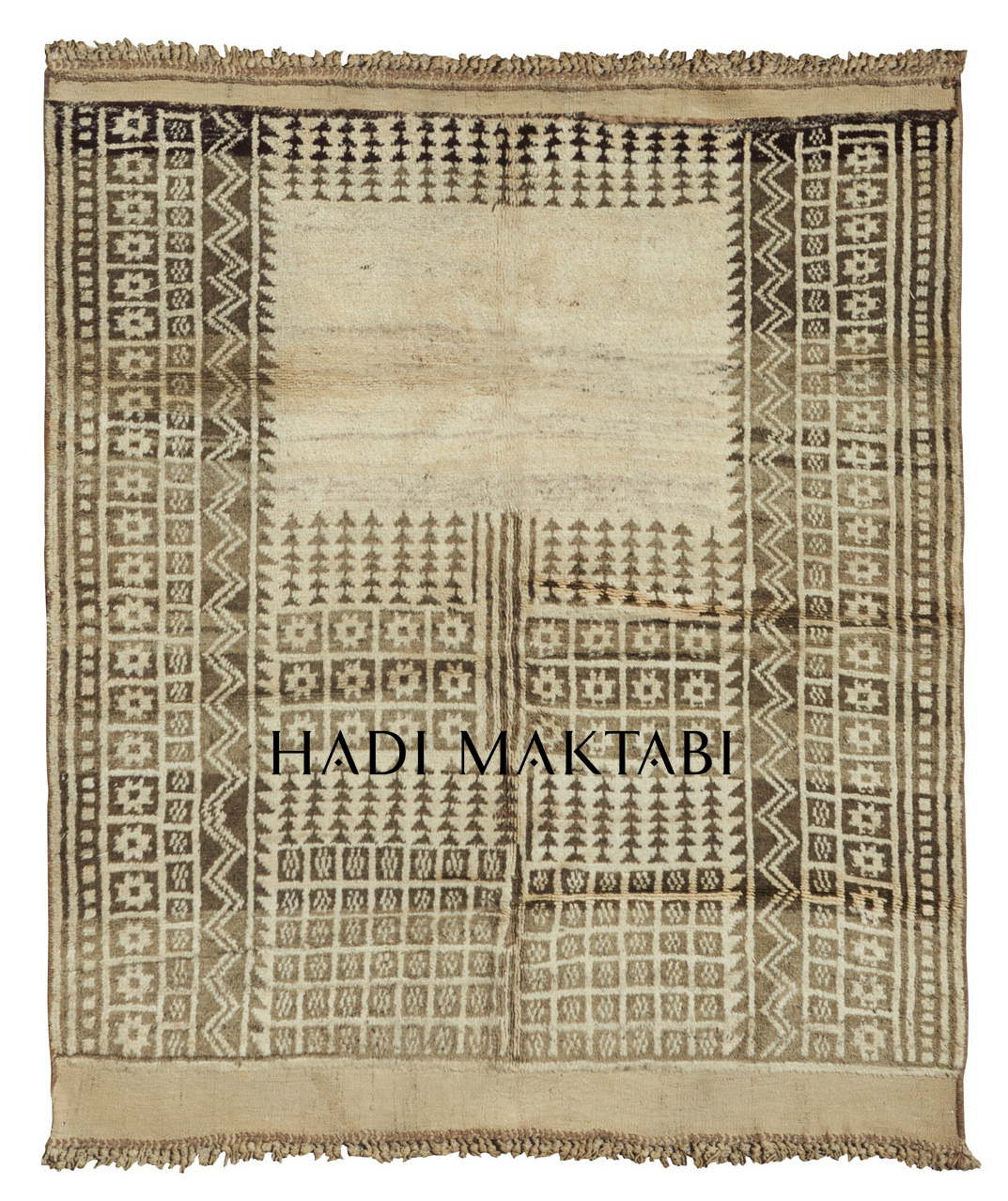
Number 505
Material Wool
Style Geometric
Origin Gabbeh
Type Tribal
Size 167 x 171
Age 1900
Gabbehs like this have become fashionable and appealing in recent years. These peculiar tribal rugs are thought to have been woven by Arab clans residing in the Jiroft area near the Persian Gulf. There are no dyes used here, just a clever and skillful manipulation of natural undyed wool of both white and black sheep 🐑 varieties. Various geometric accents are in play while leaving a blank open space in the center-top. Perhaps intended as a prayer rug?
Unusual square size and very appealing, decorative earthy tones.
The idea of purchasing valuable rugs and other artwork online from an overseas seller is daunting for several reasons, not least of which is the fact that, not being able to examine and feel the rug for yourself, you are never entirely certain that the origin, age or condition of the rug corresponds with the dealer’s description. For me, I could never take this step unless I had absolute trust in the integrity of the dealer, and my recent experience with Hadi confirms that my faith in him was well placed. Every detail of the antique rug expertly explained by Hadi was accurate and when I finally received the actual rug, it turned out to be even more stunning than his photos depicted. F. Alsagoff, Singapore
J’ai fait la connaissance de Hadi lors de la préparation de l’exposition « L’Empire des roses, chefs-d’œuvre de l’art persan du 19ème siècle » qui a eu lieu au Louvre-Lens en 2018 et à laquelle il a participé par le prêt de tapis exceptionnels. J’avais alors été impressionnée par ses connaissances et sa passion pour les tapis orientaux. Cette rencontre a marqué le début d’une collaboration riche et fructueuse. Elle a notamment permis au musée du quai Branly-Jacques Chirac de voir ses collections iraniennes s’enrichir de plusieurs tapis et tentures dont certains n’ont pas leur équivalent dans les musées occidentaux. Ce que j’apprécie chez Hadi ? C’est son professionnalisme, son dynamisme et l’engouement qu’il a pour son métier ! Hana Chidiac, Curator of the Middle East Department at the Musee Quai Branly - Jacques Chirac, Paris, France 🇫🇷
Hadi Maktabi and his staff provide comprehensive and thoughtful services to collectors and textile buyers worldwide. His knowledge of antique oriental rugs and textiles, including many fine offerings from the Levant, is unsurpassed. We have been loyal customers for over five years and have visited his Beirut premises. He has worked with us upon several occasions to select the exact Ottoman and Levantine pieces we wanted for our collection. You can be sure of quality and honesty when dealing with Hadi. Penelope and Timothy Hays, Just In From The East Collection, Florida 🇺🇸

 Email List
 Request Offer