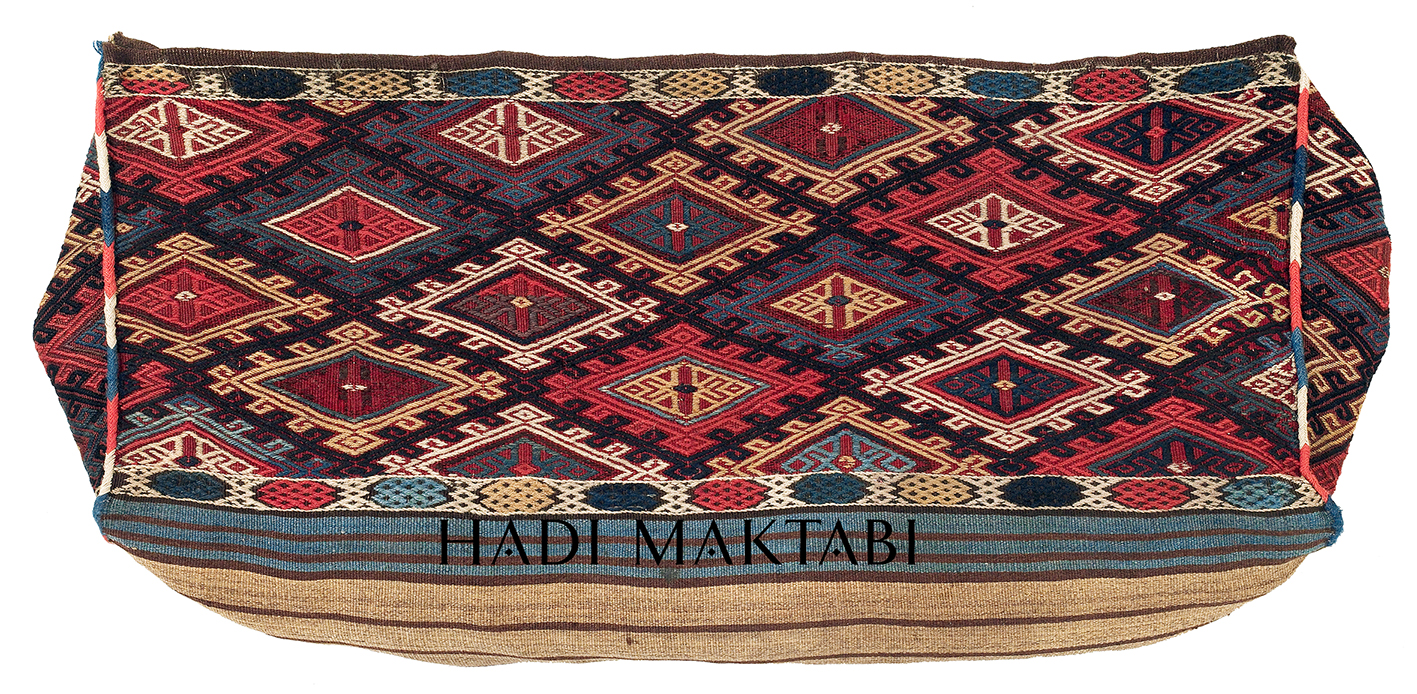
Number 774
Origin Shahsavan
Material Wool
Style Geometric
Type Tribal
Size 100 x 44 x 44
Age 1870
An excellent example of nomadic art from the mid 1800s. This is a complete and intact bedding bag (called 𝘮𝘢𝘧𝘳𝘢𝘴𝘩) which would be placed with the central section on the ground within a tent, and tied alongside each side of a horse, donkey or camel during migration. Its purpose was to store the various bedding items of a nomadic household: pillows, mattresses, covers etc. It is quite rare to find 𝘮𝘢𝘧𝘳𝘢𝘴𝘩 bags in such perfect condition and usually they appear in disjointed fragments. They are excellent examples fo functional weaving art.
This attractive example is radiant with its gorgeous natural dyes. Woven in sumakh technique (all in one piece on one loom at one time) with the central section in kilim.
Acquiring a piece from my dear friend Hadi is truly a journey. We start that journey with a lesson and detailed background on any piece that is of interest. After a thorough discussion regarding the chosen piece or should I say marvel, since Hadi's pieces are truly marvels, Hadi guides us into why he would advise us to acquire it or go for another of his marvels that would suit us more than the one initially chosen. This sincere advice always makes us feel that we are generously taken care of by Hadi. The learning process and honesty in guidance make us go back only to Hadi whenever we are looking for our next beautiful piece for our homes. All I can say is thank you Hadi for your impeccable guidance and service. Abdullah Al-Awadhi, Kuwait 🇰🇼
I must say this one of the most enriching carpet purchase experiences I ever had. This was not a mere transaction but more an experience about art and history. Dr Maktabi's experience and knowledge in this space is second to none. Highly recommended! R.A., Doha, Qatar
I have been buying and collecting oriental rugs for over 40 years. As a result I have had direct experiences with many dealers and galleries throughout Europe, North America, the Middle East and Asia. The Hadi Maktabi establishment is distinct and unique. It is rare to find a dealer who not only has a discerning taste and excellent choice of rugs. But with Hadi, the experience is one of an erudite oriental rug scholar paired with years of family experiences and traditions dealing in rugs, carpets and textiles. The available choices, diversity and quality of his stock is awesome. It is always a pleasure. Highly recommended and satisfying. As a collector he has become not only a partner of choice, knowledge and information but also a valued friend. Robert Bell, CEO Royal Brompton & Harefield NHS Foundation Trust, U.K. 🇬🇧

 Email List
 Request Offer