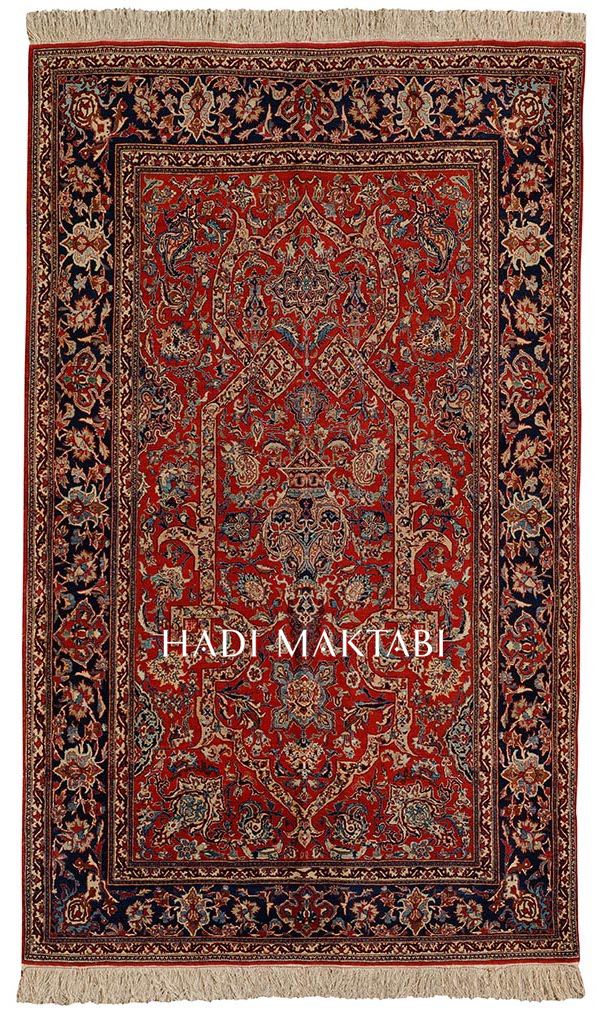
Number 574 - 575
Type Workshop
Material Wool
Style Geometric
Origin Tudeshk
Size 220 x 148 + 215 x 151
Age 1920
Tudeshk is a tiny village situated halfway along the 300 km long old Isfahan - Nain highway. During the second quarter of the 20th century carpets were made there that were markedly finer and more majestic than their legendary counterparts in Isfahan itself or Kashan. For a period of two decades or so some of the finest Persian carpets came out of Tudeshk. This ended when an earthquake struck in 1957 after which its weavers migrated to Nain and set up carpet production there.
This formidable pair of rugs reflects some of the best properties associated with Tudeshk. The saturated burgundy tones, the asymmetric or directional drawing, the knot count, the finesse of the original fringes, the suppleness of the handle.. As good as it gets. These factors are typical of early generation Tudeshk weaving in the 1920s. Pairs are always harder to find than single pieces, even more so when they are this exquisite and in such perfection of condition.
J’ai fait la connaissance de Hadi lors de la préparation de l’exposition « L’Empire des roses, chefs-d’œuvre de l’art persan du 19ème siècle » qui a eu lieu au Louvre-Lens en 2018 et à laquelle il a participé par le prêt de tapis exceptionnels. J’avais alors été impressionnée par ses connaissances et sa passion pour les tapis orientaux. Cette rencontre a marqué le début d’une collaboration riche et fructueuse. Elle a notamment permis au musée du quai Branly-Jacques Chirac de voir ses collections iraniennes s’enrichir de plusieurs tapis et tentures dont certains n’ont pas leur équivalent dans les musées occidentaux. Ce que j’apprécie chez Hadi ? C’est son professionnalisme, son dynamisme et l’engouement qu’il a pour son métier ! Hana Chidiac, Curator of the Middle East Department at the Musee Quai Branly - Jacques Chirac, Paris, France 🇫🇷
“I practically furnished my entire home with carpets from Hadi. The process was not only a joy but it was also a learning experience for me. Hadi was super helpful in identifying the right pieces for my home that would both work with my taste, budget, sizes required and that would be a good investment for my family. Hadi’s collection is second to none, and his knowledge and service is truly the blessing on top.” Amr Banaja, Public Investment Fund, Riyadh, Saudi Arabia 🇸🇦
I first met Dr. Maktabi as a lecturer on carpet history and was captivated by his passion for the subject. Only later I knew him as a dealer, though even in our financial transactions, Hadi has been a gentle guide and friend. He has understood my taste and interests and made wonderful suggestions, but never in a pushy way. That is to say I have enjoyed working with him on several levels and wish to continue our excellent relations and dealings far into the future. A. Harvey Pincis, formerly Dar Al Athar Al Islamiyyah Museum (Kuwait), Latvia 🇱🇻

 Email List
 Request Offer