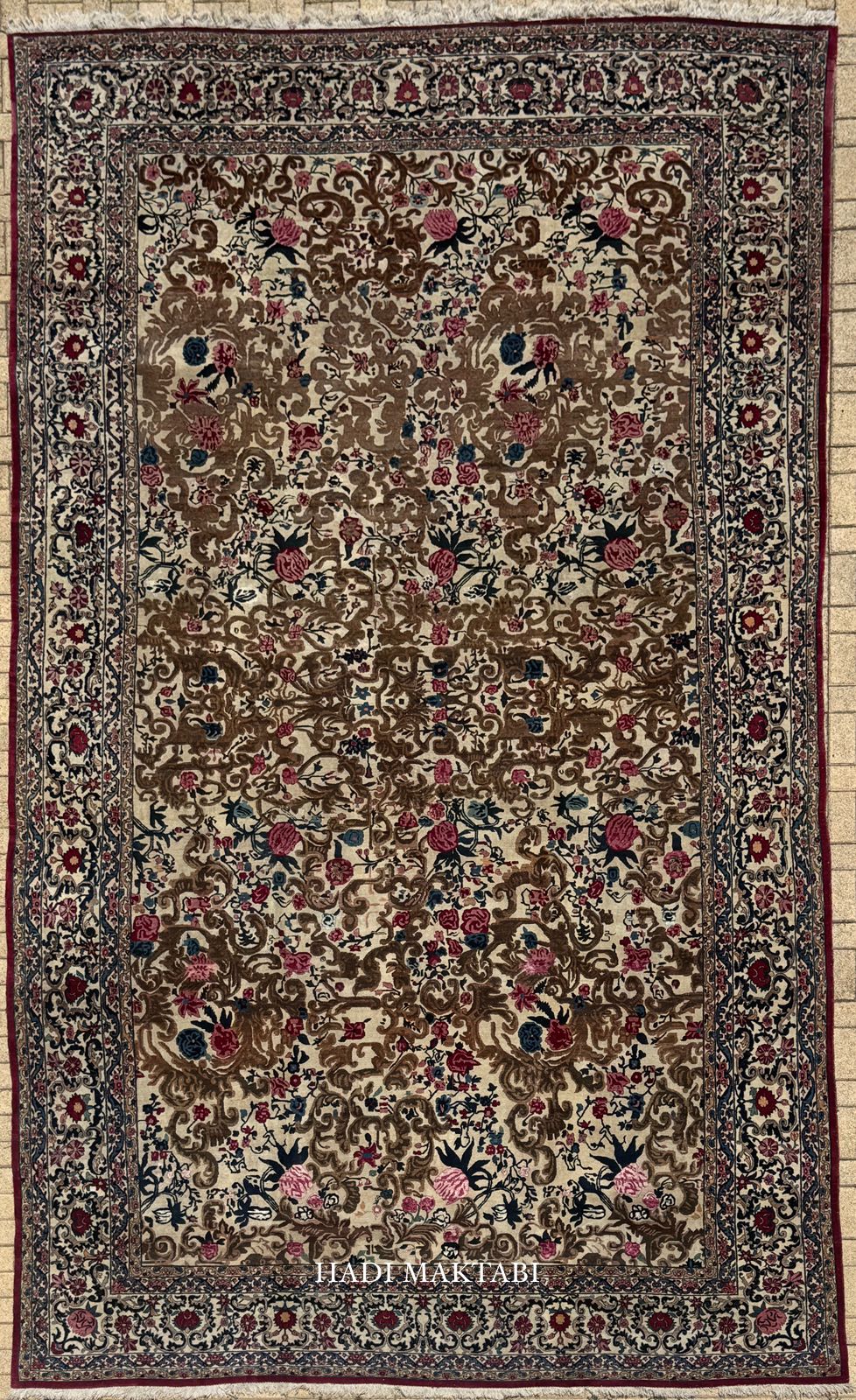
Number 24425
Type Workshop
Style Flowery
Material Wool & Silk
Origin Tehran
Size 523 x 302
Age 1885
This is one of the most beautiful, exhilarating and ambitious Tehran carpets I have seen. It is one of 3 I have encountered with this sweet 𝙂𝙤𝙡 𝙁𝙖𝙧𝙖𝙣𝙜 pattern executed on a finely woven ivory crème field. (You can find another, half the size here 𝚠𝚠𝚠.𝚑𝚊𝚍𝚒𝚖𝚊𝚔𝚝𝚊𝚋𝚒.𝚌𝚘𝚖/𝚌𝚊𝚛𝚙𝚎𝚝/𝟷𝟿𝟼.)
This pattern, in its famous and well-known form, developed in Russian Karabagh, across the Araxes River from Persia, under imperial Romanov auspices. (You can find one of the oldest or earliest of this type here: 𝚠𝚠𝚠.𝚑𝚊𝚍𝚒𝚖𝚊𝚔𝚝𝚊𝚋𝚒.𝚌𝚘𝚖/𝚌𝚊𝚛𝚙𝚎𝚝/𝟻𝟶𝟸.) The Karabagh prototypes were woven for the Russian court and aristocracy in St Petersburg and were modeled on Imperial French textiles and weavings (e.g. Aubusson carpets) from the period of Napoleon III. Their royal and sumptuary links caused the Romanov and then the Qajar dynasties to both in turn adopt this design as their own. The Karabagh antecedents were all woven on dark blue or brown backgrounds: the Tehran variants (the 3 being discussed here) stand out for their white fields. Cream toned Tehran rugs are very rare, as are any Persian rugs of the 19th century of any type whatsoever.
The ivory ground here offers a very sweet and tender backdrop to the curling vines and rising ivy, with all geraniums and roses executed in pink, red and white silk highlights. The effect is both sublime and magnificent. It feels truly royal. Please note this carpet was not made for commercial usage but for a Qajar palace or residence. It is extremely rare not only for its colors and design but also for its scale. The gigantic dimensions make the viewer or guest really feel they are within a private, secret garden.
I first met Dr. Maktabi as a lecturer on carpet history and was captivated by his passion for the subject. Only later I knew him as a dealer, though even in our financial transactions, Hadi has been a gentle guide and friend. He has understood my taste and interests and made wonderful suggestions, but never in a pushy way. That is to say I have enjoyed working with him on several levels and wish to continue our excellent relations and dealings far into the future. A. Harvey Pincis, formerly Dar Al Athar Al Islamiyyah Museum (Kuwait), Latvia 🇱🇻
As a carpet collector of 30 years, I have noticed a decline in the amount of truly unique and high quality carpets on the market. I have also noted a decline in the knowledge of merchants, generally. Hadi Maktabi stands against this trend as a both a curator for and an educator of his clients. His offerings are well-researched, museum quality carpets that are both singular and expertly chosen. In dealing with Hadi, I have experienced excellent communication, a high standard of service and extremely pleasant interactions. Warren D., Hong Kong 🇭🇰
Hadi Maktabi and his staff provide comprehensive and thoughtful services to collectors and textile buyers worldwide. His knowledge of antique oriental rugs and textiles, including many fine offerings from the Levant, is unsurpassed. We have been loyal customers for over five years and have visited his Beirut premises. He has worked with us upon several occasions to select the exact Ottoman and Levantine pieces we wanted for our collection. You can be sure of quality and honesty when dealing with Hadi. Penelope and Timothy Hays, Just In From The East Collection, Florida 🇺🇸

 Email List
 Request Offer