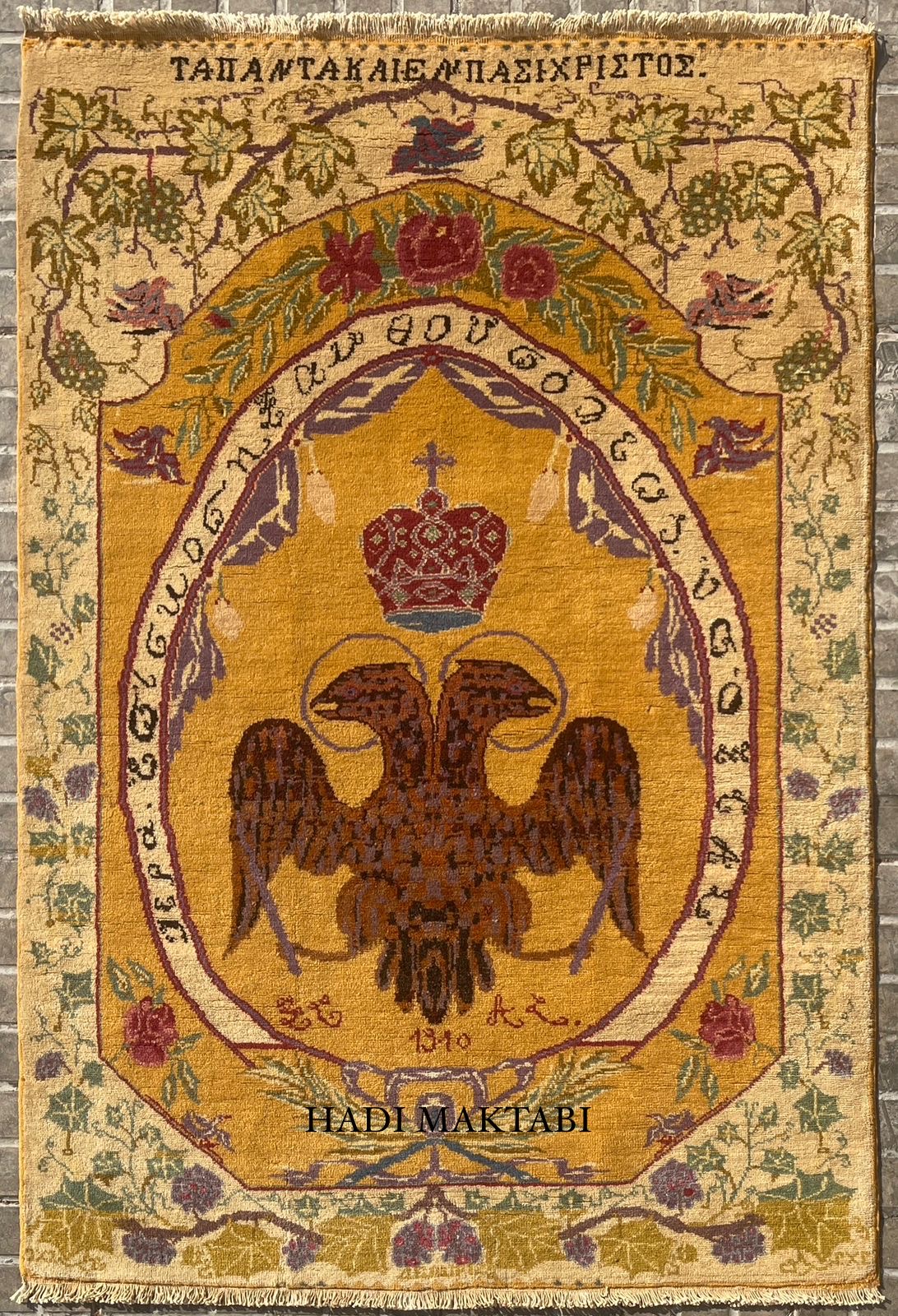
Number 1908
Material Wool
Style Prayer Rug
Type Anatolian
Origin Anatolian
Size 144 x 98
Age 1910
This is a unique & brilliant Ottoman-era religious carpet woven by the native Greek community of Cappadocia in Asia Minor in 1910, the descendants of the ancient Hellenic & Byzantine peoples who had lived there for over 4,000 years.
The field is dominated by the double-headed eagle bearing two swords ⚔️ in its talons, the famous emblem of the Byzantine emperors and, subsequently, the Greek Orthodox Patriarch of Constantinople. It represented the Emperor’s dual suzerainty over the temporal and spiritual worlds or, alternatively, the eastern and western spheres of Christianity. In short, power. The eagle 🦅 is topped by an ecumenical crown 👑 with cross, representing the emperor (and after 1453, the GO Patriarch) as Christ’s vicar on earth.
The roundel bears a Greek inscription which reads 𝙃𝙤𝙡𝙮 𝘾𝙝𝙪𝙧𝙘𝙝 𝙊𝙛 𝘼𝙣𝙩𝙝𝙤𝙪𝙥𝙤𝙡𝙞. The top end of the rug has a further inscription ΤΑ ΠΑΝΤΑ ΚΑΙ ΕΝ ΠΑΣΙ ΧΡΙΣΤΟΣ: Everywhere and in everything lives Christ. Further writings appear in the lower part.
The golden saffron field is very eye catching and reflects medieval Byzantine imperial and ecclesiastical banners, which you may still see today outside churches in Greece and elsewhere in the Green Orthodox & Greek Catholic world. The rug has melodious purple and sweet green tones which do not show so well in these hurried photos I took indoors (rain etc). The flower garland above the crown and the blossoming vines above that are delightful.
I first met Dr. Maktabi as a lecturer on carpet history and was captivated by his passion for the subject. Only later I knew him as a dealer, though even in our financial transactions, Hadi has been a gentle guide and friend. He has understood my taste and interests and made wonderful suggestions, but never in a pushy way. That is to say I have enjoyed working with him on several levels and wish to continue our excellent relations and dealings far into the future. A. Harvey Pincis, formerly Dar Al Athar Al Islamiyyah Museum (Kuwait), Latvia 🇱🇻
The idea of purchasing valuable rugs and other artwork online from an overseas seller is daunting for several reasons, not least of which is the fact that, not being able to examine and feel the rug for yourself, you are never entirely certain that the origin, age or condition of the rug corresponds with the dealer’s description. For me, I could never take this step unless I had absolute trust in the integrity of the dealer, and my recent experience with Hadi confirms that my faith in him was well placed. Every detail of the antique rug expertly explained by Hadi was accurate and when I finally received the actual rug, it turned out to be even more stunning than his photos depicted. F. Alsagoff, Singapore
You can't only be a customer of Hadi Maktabi. While his main purpose is rug dealing, he starts with story telling and ends with history selling. That's what I call high-end art curating and closing it all with an entertaining friendship. George El Hani, CEO Levica, Lebanon 🇱🇧

 Email List
 Request Offer