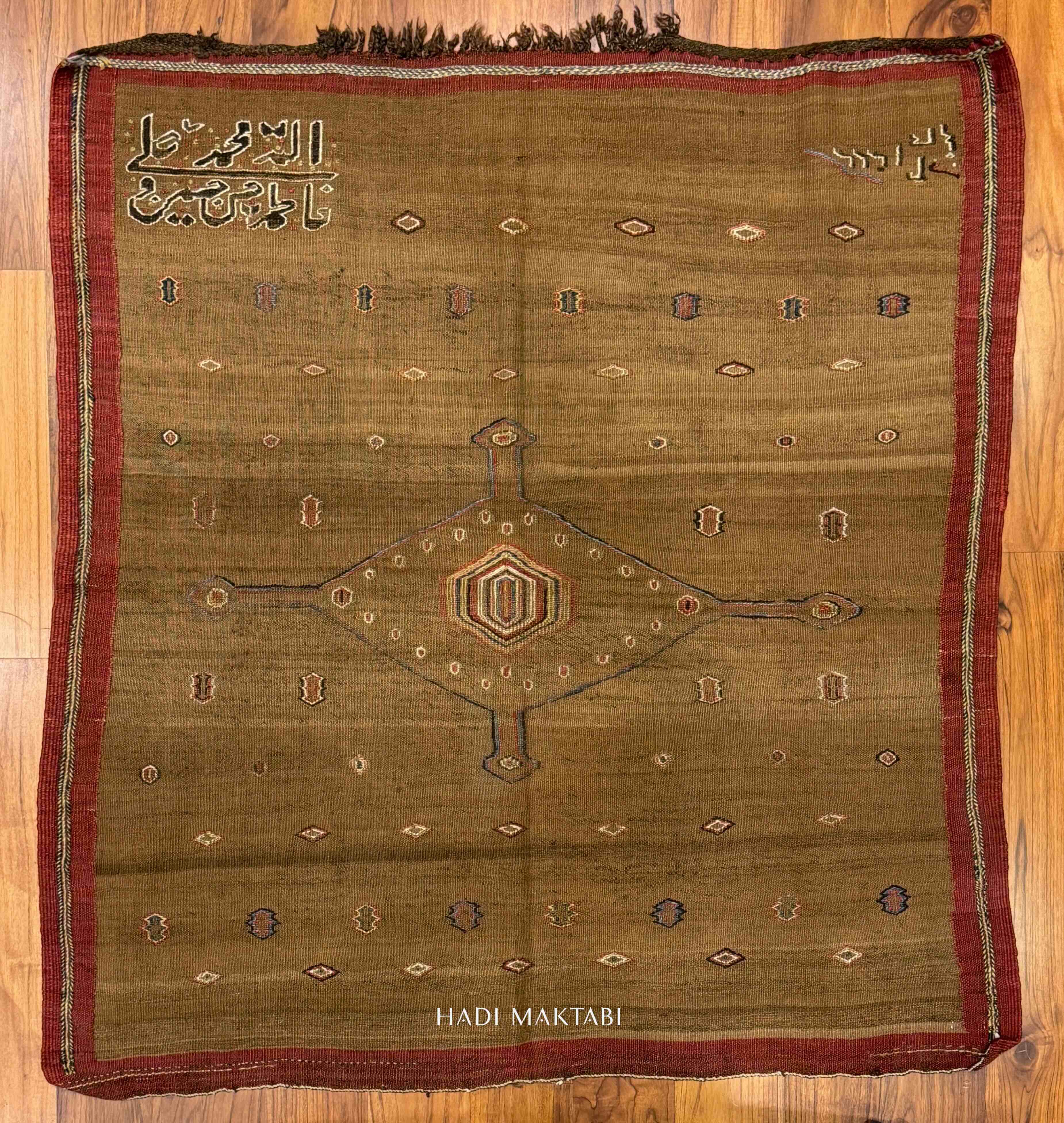
Number cc749
Origin Shahsavan
Material Camel Hair
Style Prayer Rug
Type Kilim
Size 153 x 140
Age 1322 (1904)
Now this is a find. A rare find. A very rare find indeed.
It was most likely woven by the Shahsavan nomads of the Sarab district in northwest Persia in mixed flat-weave techniques: the soft camel hair field is kilim woven, as is the thin red border while the central medallion, tribal motifs across the field, and pin striping within the border are all executed in 𝘚𝘶𝘮𝘢𝘬𝘩 stitch weave.
This historically valuable artwork has the distinctive square shape, flat woven nature and dimensions of a tribal "eating cloth" 𝙎𝙤𝙛𝙧𝙚𝙝. It would be laid out on the grass or the sand, and the family's food would be served on it. Very few old ones survive.
What makes this specific 𝙎𝙤𝙛𝙧𝙚𝙝 so unique and incredible is the fact that it is inscribed-- at a time when the vast plurality of nomadic peoples, in Persia or elsewhere, were entirely illiterate.
The left hand side inscription is of a religious nature; it mentions the holy names of Allah, (Prophet) Mohammad, (Imam) Ali, (Saydeh) Fatima, (Imam) Hasan and (Imam) Hossein. Apart from God, these holy figures were the 𝘗𝘢𝘯𝘫 𝘛𝘢𝘯, the 5 Holy People of 𝘈𝘩𝘭 𝘈𝘭-𝘉𝘢𝘺𝘵, the Prophet's household. Note how elegant, balanced and detailed the inscription is.
The inscription on the right hand side is in mirror writing, legible from the back side of the 𝙎𝙤𝙛𝙧𝙚𝙝. It bears the date 1322 equivalent to 1904. In short, it is obvious that this was no mere eating cloth but in fact a prized and cherished item that utilized expensive camel hair and was commissioned on behalf of a high ranking individual-- in this case, indubitably, the chief Khan of the Shahsavan tribe.
Purchasing carpets from Hadi Maktabi was the epitome of professionalism and joy. Hadi is an expert curator, purveyor, historian and story teller. His passion, knowledge, professionalism and expertise are evident every step of the way. With a wide range of choices and prices, prompt service, and fast sipping, we had our carpets in Sydney in a matter of days. The ultimate flying carpet experience! Zeina Tebbutt, Sidney, Australia 🇦🇺
As a carpet collector of 30 years, I have noticed a decline in the amount of truly unique and high quality carpets on the market. I have also noted a decline in the knowledge of merchants, generally. Hadi Maktabi stands against this trend as a both a curator for and an educator of his clients. His offerings are well-researched, museum quality carpets that are both singular and expertly chosen. In dealing with Hadi, I have experienced excellent communication, a high standard of service and extremely pleasant interactions. Warren D., Hong Kong 🇭🇰
You can't only be a customer of Hadi Maktabi. While his main purpose is rug dealing, he starts with story telling and ends with history selling. That's what I call high-end art curating and closing it all with an entertaining friendship. George El Hani, CEO Levica, Lebanon 🇱🇧

 Email List
 Request Offer